Slovenia's new average speed cameras — where they are and when the fines start
Social media says Slovenia's section control went live on 1 September. It did not. Here is the verified status, all four stretches with lengths and limits, and what still has to happen before a single fine is issued.
TollTracker for iOS and Android
Speed cameras, average speed and enforcement zones, always up to date.
Slovenia's new average speed cameras — where they are and when the fines start
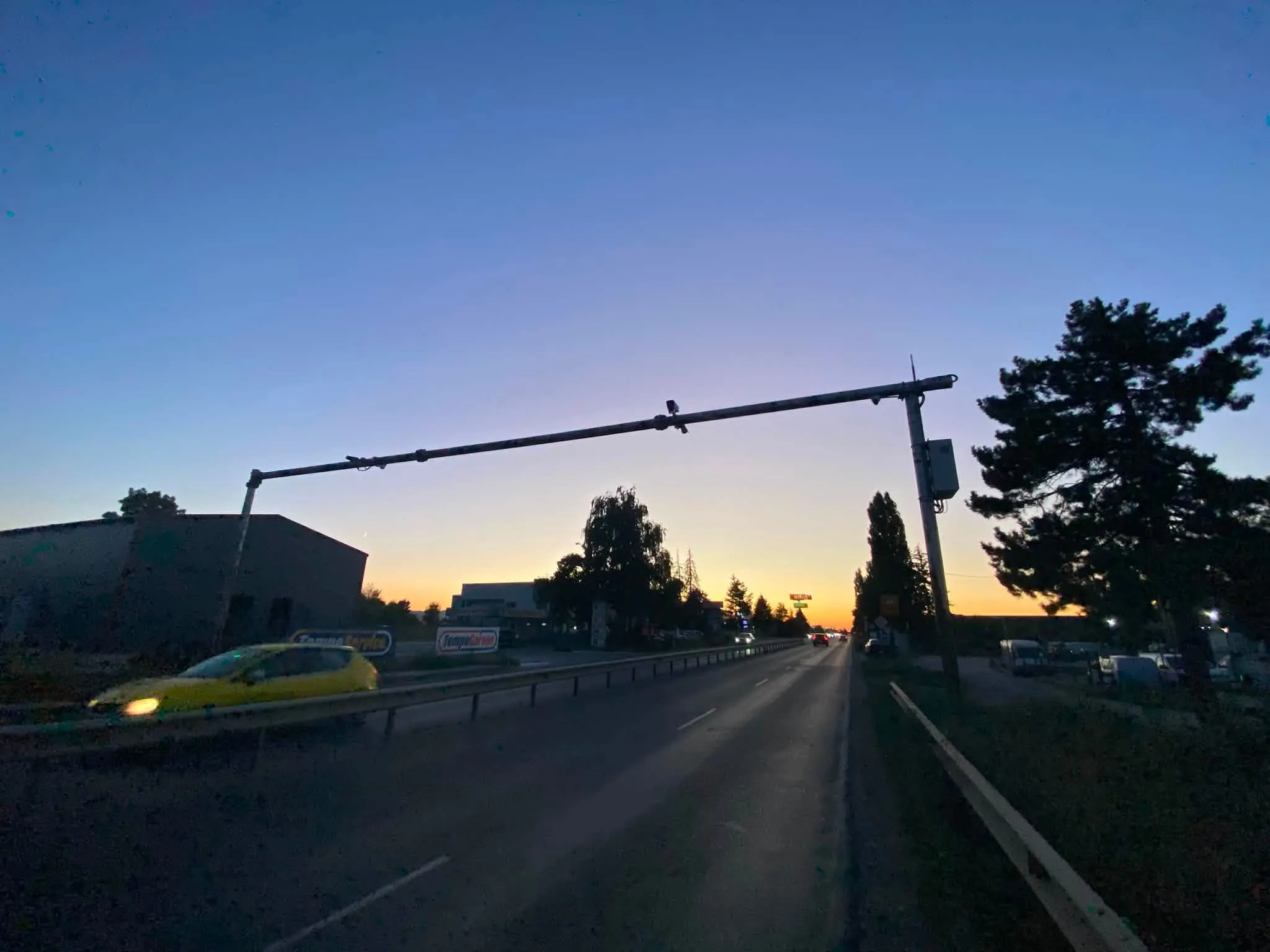
Since the start of September, Slovenian driver groups have been passing around the same claim: section control is live, the fines have started. Photos of gantries, warnings about Trojane, the lot.
The reality is simpler. The equipment is installed, three of the four stretches are certified, and no fines are being issued.
If you drive through Slovenia on the way to Italy, Austria or the Balkans, three of these four stretches sit directly on your route. Here is what is actually confirmed.
Where things stand
As of 13 September 2026, Slovenia's average speed cameras are not issuing fines.
- The equipment is installed on all four stretches. The infrastructure work is finished.
- Slovenia's Metrology Office (Urad RS za meroslovje) completed the first certification of three of the four stretches in early September. Certification is what makes a device legally usable in penalty proceedings.
- The fourth — Podmilj–Ločica, below the Trojane tunnels — is not certified. The supplier modified the devices after the original application, so that stretch goes back through the process.
- DARS, the motorway operator, will only take the system over once all four stretches are operational and certified.
- DARS has committed to announcing the start date publicly and in advance. Until then the devices are in testing.
So: the cameras are there and they are legally sound, but the chain that ends in a fine is not closed yet.
The four stretches
The four sections sit on the main arms of Slovenia's motorway cross — the Primorska and Gorenjska motorways around Ljubljana, the Dolenjska motorway toward Novo Mesto, and the Štajerska motorway below Trojane.
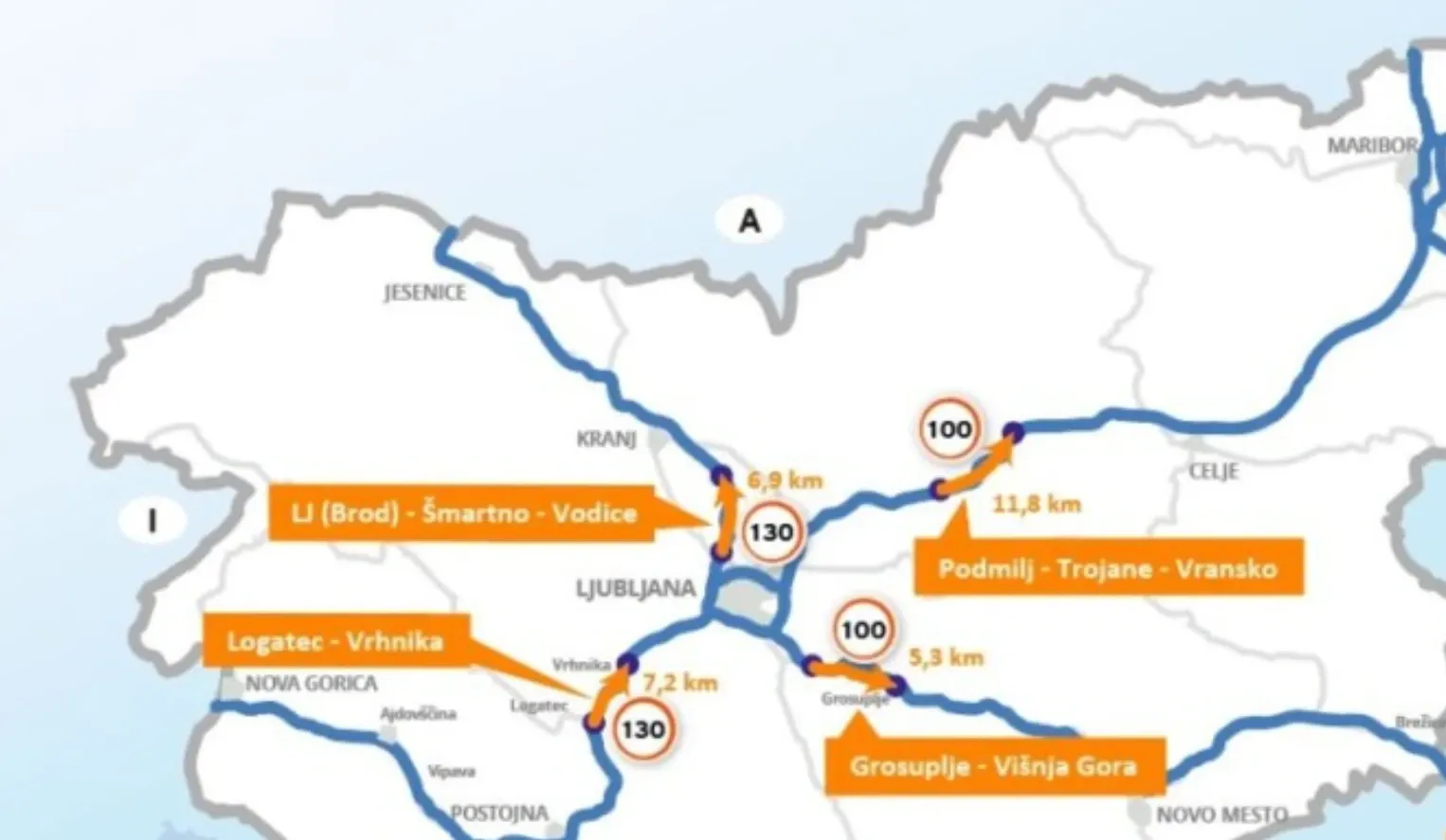
According to the DARS scheme:
- Logatec – Vrhnika, toward Ljubljana — roughly 7.2 km, limit 130 km/h. Certified. Covers the hard shoulder, driving and overtaking lanes.
- Ljubljana (Brod) – Šmartno – Vodice, toward Kranj — roughly 6.9 km, limit 130 km/h. Certified. Same three lanes.
- Grosuplje – Višnja Gora on the Višnja Gora hill, toward Novo Mesto — roughly 5.3 km, limit 100 km/h. Certified. Covers the driving and overtaking lanes. The metrology paperwork calls the same stretch Grosuplje–Ivančna Gorica.
- Podmilj – Trojane – Vransko, toward Maribor — roughly 11.8 km, limit 100 km/h. Not certified. Listed in the paperwork as Podmilj–Ločica.
The equipment is iCar5, made by the Belgian manufacturer MacQ and integrated by Intermatic.
What still has to happen
Certification is only one condition. According to DARS, before official measurement begins the supplier must still:
- complete operator training;
- connect the system to the police information system;
- and the police must test the devices and the automated data processing.
Only then do official measurements — and fines — begin. There is no date, only a promise that it will be announced in advance.
How section control differs from a fixed camera
This is the part that catches people out.
A fixed speed camera photographs you at a single point, at whatever speed you happen to be doing right there.
Section control records you entering and leaving the stretch — plate and precise timestamp — then divides the length of the stretch by your travel time. The result is your average speed across the whole section.
Which is why the old reflex — brake for the camera, then back on the throttle — does nothing here. There is no camera to brake for. The entire distance is measured.
The reverse is also true, and worth knowing: if you drove the stretch sensibly, one brief overtake will not push you over. The system reads the average, not the peak.
When it will not be measuring
One condition matters: the speed limit has to be identical along the whole measured stretch.
If the limit changes because of roadworks or variable signage, section control on that stretch is not expected to operate. So an active work zone probably will not be measured this way — which of course does not mean you are not being measured some other way.
What it costs
Fines are set by Slovenia's Road Traffic Rules Act and do not depend on whether the speed was caught by a fixed camera or as a section average. On motorways and expressways, the figures are roughly:
| Over the limit | Fine | Penalty points |
|---|---|---|
| up to 20 km/h | €40 | — |
| over 20 to 30 km/h | €60 | — |
| over 30 to 40 km/h | €120 | — |
| over 40 to 50 km/h | €250 | 3 |
| over 50 to 60 km/h | €400 | 5 |
| over 60 km/h | €1,200 | 9 |
Foreign plates are not a loophole. Slovenia exchanges vehicle-owner data with other EU states, so a fine caught on a stretch near Ljubljana can reach an address in Vienna, Milan or Munich.
DARS is clear that the point is lower average speeds and fewer serious crashes rather than revenue — the same argument Austria made for its own section control, which has been running for years.
Until then, the fixed cameras are working normally
While section control waits for its green light, Slovenia's fixed speed cameras are operating as usual. TollTracker currently tracks 273 speed cameras in the country.
The app does two things that matter on exactly these roads:
- it warns you ahead of the camera, early enough to check your speedometer calmly instead of braking hard at the last moment;
- and on average speed stretches it shows your running average in real time — so you can see what the system is calculating while you are still on the section, not when the letter arrives.
We will add these four stretches to the map the day DARS confirms the official start, not on the strength of a social media post.
See the speed camera map for Slovenia, or open the full enforcement map for Slovenia.
If you drive this corridor regularly, download TollTracker — the point is not to outwit the camera, it is to know where it is before you have already passed it.
We are following the process and will update this article the day DARS announces the real start date.
TollTracker for iOS and Android
Speed cameras, average speed and enforcement zones, always up to date.